Once I was a thought
Inside the mind of God;
He held me and he shaped me
In lands where angels trod;
Perhaps he saw a flower,
Perhaps he smelt a rose,
Perhaps he saw a sunset
Spread out in miles of gold...

Perhaps it's then he thought me;
Perhaps it's then he knew,
"This one shall be a little child
Beneath the sky of blue.
A dew-drop like a pearl,
A sunbeam on the day,
Someone's little sweetheart
To bless them on their way."

So one by one he gathered
Each thought with tender care,
Along the paths of heaven
Among the gardens fair;
And like a gentle artist
Who moulds with tender skill,
He fashioned all my members
According to his will.

He counted every finger,
My ears and all my toes;
He even gave me little hairs--
Each one he says he knows.
And then there is a dimple
Stuck in my little chin--
He told me that he put it there
To remind me it was him.

Then one day I was ready--
Each eyelash was in place,
And every little curl
Around my reddish face;
And then there came a time--
It was the time of birth--
He said, "Dear child of mine,
It's time to touch the earth."

From where his love had placed me
Upon his weaving loom,
His hands reached forth and drew
Me from my mother's womb.
And on her breast I swaddled
And drew there my first breath
And tasted all the sweetness
Prepared 'twixt life and death.

And then I heard a low voice
Smile close above my head;
"This precious life is God's gift--
She's lent to us," he said.
"We thank you, Lord, for Gretel,
Our lovely rose, ornate;
This little pearl who shows us
Our human love incarnate."
“You knit me together in my mother’s womb.” -Psalm 139:13
When I was small and could not lift my head, So helpless that I needed to be fed, And could not help myself out of my bed— Dear Mama, you were there.
When I couldn’t match my skirt and top aright, Nor tie my hair up in a pony tight, And when I did not know twixt wrong and right— Dear Mama, you were there.
And when I walked through many painful strifes, And had so many questions about life, Then one day gave my vow to be a wife— Dear Mama, you were there.
With all your heart and love so full and true You led me, showed me, taught me all you knew: I know I need not fear a path that’s new— For Mama, you are there.
I wish in years of waiting, days of pain, And times when all we see is rain, That all your faith, and hope, and love remain— For Mama, God is there.
There is a look that autumn hues can’t paint,
And there are streams that leave the thirsty faint;
There is a gleam that winter cannot throw
Across the hills beneath a sunset glow…
And there are combs of nectar,
And there are drops of dew,
And there are hoards of silver,
But not another you.
For water has its courses
By rocks and canyons through,
The beehives have their honey,
But, sweetheart, I have you.

Within the azure dome the sparrow flies,
And to the depths the shiny dolphin dives,
And far into the mountains grizzlies haunt
The berry bushes, and the dens they want…
The hills have all their valleys,
The oceans all their hue,
The sky has all its colours,
But not a man like you.
For woodlands have their silence
And charms beyond a few,
The birds have their companions,
But, darling, I have you.

In far-off lands some men pursue their fame,
And garner gold and fortunes to their name;
While some seek pleasures, intellect, and worth
In things they know and boast of on this earth…
The world has all its wonders,
Fine art its passions true,
But none of it can equal
The love I’ve found in you.
For sunsets have their rainbows,
And seascapes have their blue,
The night has all its planets,
But, baby, I have you.
If I were a pen
And my will the ink
By which the nib was painted
And the letters linked,
I'd  tell my heart, "Be willing
To yield the gentle spilling
Of all your hopeful filling
On needy scrolls distilling
By giving this lone stem
Of wood carved to a pen
Into the Hand that men
Call God's will guiding them."

If I were a pot
And my will the tea
Of which the spout was emptied
And the body gleaned,
I'd tell myself, "Be poured out
Down through this gentle pour-spout
And never dashing without
The teacup lip—ah, don't doubt!
Your lovely liquid drink
Will be of sweetness... think:
A tender sip the brink
And taste the final link."

If I were a creek
And my will the rocks
Where freezing cascades shudder
And icy water shocks,
I'd let myself be moulded,
My rights and reasons scolded
Until my frame was folded
And all my faith emboldened
Beneath those frigid waves
Where falls crash into caves,
And polish dreams and graves,
And gems of beauty saves.

                                             If I were a pen...
“Wherefore seeing we also are compassed about with so great a cloud of witnesses, let us lay aside every weight, and the sin which doth so easily beset us, and let us run with patience the race that is set before us, looking unto Jesus the author and finisher of our faith; who for the joy that was set before him endured the cross, despising the shame, and is set down at the right hand of the throne of God. For consider him that endured such contradiction of sinners against himself, lest ye be wearied and faint in your minds.” (Hebrews 12:1-3)
In Volume Two of his magnum opus known as The Spiritual Man, Chinese Christian evangelist, author, and martyr Watchman Nee lays out for us the foundational points of spiritual life and what it looks like to “walk after the Spirit,” exhorting us to test the spirits, and to weigh everything we sense in spirit, soul, and body against the teachings of the Bible.
“The Holy Spirit,” he says, “never moves the prophets of old to write in one way and then move us today in another way.” (The Dangers of Spiritual Life p. 141). Nee’s descriptions help believers understand the operation of the spirit. “Nothing is more vital to the Christian life than to walk daily after the spirit… This is a moment by moment affair from which there can be no relaxing.” (The Dangers of Spiritual Life, p. 129). Nee also describes the absolute necessity of a believer to maintain a “responsible spirit,” and a spirit of “resistance” against enemy attacks.
Basing his teaching on the necessity of revelation through the Holy Spirit – which must coincide and harmonize with the revelation of the Holy Spirit in Scripture – and the dispersal of God’s light and truth into the believers spirit by way of the Holy Spirit, Nee describes the necessity of a well-developed intuition in order to walk steadily after the spirit without any interference from the outside. He points out the necessity of maintaining the right condition in our spirits, as well as “a positive forward-propelling heart.”
But how do we do this? We must first distinguish between the “spiritual” and the “soulical” parts of our being, and then learn to apply the laws of the spirit. “When thinking,” Nee says in his book, “[believers] should recognize the source of their thought; in feeling, they should detect the direction from which such feeling comes; and in working, they should be clear as to what strength they use. Only thus can they follow the spirit.” (The Dangers of Spiritual Life, p. 131).
Nee explains the harmful effects of indulging self-consciousness. It is “most harmful,” he explains, “since it causes us to focus upon ourselves and thereby enhance the growth of the self life… Harmful self-examination revolves around one’s own success or defeat, stimulating attitudes of self-pride or self-pity. Profitable analysis searches only the source of one’s thought, feeling or desire. God wishes us to be delivered from self-consciousness, but at the same time He certainly does not intend for us to live on earth as people without intelligent awareness.” (The Dangers of Spiritual Life, p. 131). “What every truly born-again person should rely on for living is the life of the spirit. If we are willing to be taught, we shall know what is our spiritual sense.” (p. 132).
In Volume 2 of The Spiritual Man – which we will explore here in Part 2 of this Book Review Series – Nee gives readers detailed analysis’ to questions such as:
What are the definitions and functions unique to Intuition, Communion, and Conscience?
In walking after the Spirit, what is “the way of the cross”?
What are “The Laws of the Spirit,” and how can believers apply them?
Why is it so essential that believers rely with utter dependance upon the Holy Spirit in understanding spiritual truth in the Scriptures?
Must the believer “experience everything” for himself, or can he “bypass part of the pathway” to holiness – does a bit of knowledge “insure” us against defeat – or is it faithfulness to the Lord alone that can help us “avoid many unnecessary defeats”?
In understanding The Laws of the Spirit, what are the marks of “Weights on the Spirit,” “Blockage of the Spirit,” “Poisoning of the Spirit,” “Sinking of the Spirit,” “Burdens of the Spirit,” “Ebbing of the Spirit,” “Irresponsibility of the Spirit,” and what are the steps believers can take to immediately deal with them, and claim victory and embrace the freedom and sweetness of a light, airy spirit that accompanies the strengthening of the Holy Spirit within them?
Why is defeat inevitable whenever a believer fails to guard his spirit?
What are the Principles of the Mind Aiding the Spirit, how do Mind and Spirit cooperate, and how can “praying with the mind” while engaging in spiritual warfare actually activate the spirit?
How can the mind become the “nurse of the weak spirit,” and why should the motive of mental work be to serve the spirit?
What is the function of Emotion – and is there a difference between Emotion and Inspiration?
What are the beautiful marks that accompany “A Contrite Spirit,” a “Broken Spirit,” “An Afflicted Spirit,” “A Lowly Spirit,” those who are “Poor in Spirit,” “A Gentle Spirit,” “A Fervent Spirit,” “A Cool Spirit,” “A Joyful Spirit,” “A Spirit of Power,” “A Quiet Spirit,” “Newness of Spirit,” “A Holy Spirit,” “A Strong Spirit,” “A Spirit of Grace and Rapture” – and how can we pray in the spirit with understanding in order to receive such unspeakable gifts from the Lord Jesus?
In Part Four and Five of Volume II, Nee delves into such topics as The Holy Spirit and the Believer’s Spirit, Prayer and Warfare, Intuition, Communion with the Lord, and the workings and function of man’s Conscience, its impact on man’s spiritual life, and how to distinguish the voice of conscience apart from the voice of Satan—the accuser.
In his Analysis of the Spirit, Nee says, “We ought to understand that numerous outer failures stem from the failure of the inner spirit… What the Lord is especially concerned with in the Christian is not his outer man, the soul, but his inner man, the spirit. No matter how highly developed our outer man may be, if this inner component of ours is abnormal, our whole walk shall go askew… A hard and haughty spirit always impedes the way of obedience. But when the cross is working deeply a believer comes to know himself. He realizes how undependable are his ideas, feelings and desires… except we sense our helplessness we shall never trust in God… God needs a lowly man to express His virtue. How can a proud man hear the voice of the Holy Spirit and then cooperate with God?” (p. 172, 174-175 The Normalcy of the Spirit).
In teaching on the baptism of the Holy Spirit, Nee points out: “Broadly speaking, a Christian who has not yet experienced the baptism in the Holy Spirit is rather vague about the reality of the spiritual realm. He is like the servant of Elisha whose eyes were closed to that sphere. He may receive instructions from the Bible, yet his understanding is confined to the mind because he still lacks revelation in his spirit.” (p. 55 Prayer and Warfare). Nee’s explanation harmonizes with the words of Christ in John 3:3, 5-6: “Verily, verily, I say unto thee, Except a man be born again, he cannot see the kingdom of God… Except a man be born of water and of the Spirit, he cannot enter into the kingdom of God. That which is born of the flesh is flesh; and that which is born of the Spirit is spirit.”
In evaluating the normalcy of the spirit, Nee points out the necessity of maintaining a contrite and broken spirit before the Lord (Psalm 51:16-17 and Isaiah 57:15; Isaiah 66:2) as well as cultivating a lowly, poor, and gentle spirit before men, and a fervent, joyful, holy, and strong spirit in performing the work of God. Nee points out that in life, communication, and service, “The Holy Spirit alone can grant us the strength required by the inner man.”
Nee paints for us a clear picture of what it means to walk after the Spirit and how to follow the laws of the Spirit. He not only gives a helpful description of The Principles of the Mind Aiding the Spirit in spiritual warfare but also delivers a detailed Analysis of the Soul—Emotion.
Nee warns believers to beware of emotion counterfeiting the moving of the Holy Spirit, and exhorts them to a careful understanding in order to distinguish between the two, for, he explains, “Not emotion but communion with the Lord in the spirit is what is valuable before God.” (p. 133). He examines the life of Paul, quoting Galatians 1:16-17: “God ‘was pleased to reveal his Son to me, in order that I might preach him among the Gentiles,’ (and) ‘I did not confer with flesh and blood, nor did I go up to Jerusalem to those who were apostles before me, but I went away into Arabia; and again I returned to Damascus.” (p. 134). Paul cared not what men would think or say of him. He was content and confident to follow the leading of the Holy Spirit in his intuition, rather than trusting in human reason, argument, mind, or intellect.
Nee exhorts Christians to be vigilant against enemy attacks: “An emotional Christian,” he says, “is easily defeated in conflict with Satan. Spiritual warfare… demands an attitude of total death to feeling and an absolute trust in God.” (p. 253). In describing the stance believers must assume against the attacks of Satan, Nee asks: “In view of the significance of our spirit, which is the site of communion between the Holy Spirit and the saints, should we marvel if Satan is most unwilling to let us know the functions of the spirit for fear we may follow it?… he [the devil] musters his whole force to attack the believer’s spirit.” (p. 136). But how shall the believer resist such attacks? “To examine and test our walk is a very important element in following the spirit. Believers… must examine carefully all thoughts, feelings, etc., which come to them in order to discern whether these arise from God or from themselves.” It is necessary also that believers recognize the accusations of Satan, for he [Satan] “is alert to the fact that the children of God can make no progress spiritually unless they have a heart full of confidence.” (p. 138). He exhorts us to understand “real conviction,” aside from the myriad accusations construed by the enemy to handicap believers and keep them in bondage or fill them with “a false peace.” Real conviction comes from the Holy Spirit and “leads us to holiness.” But the motive of Satan is merely “to make Christians suffer.” In resisting false accusations, it is absolutely essential that the believer declare out loud the victorious name of the Lord Jesus and plead the precious cleansing of the blood of the Lamb. “We must realize most assuredly that the Holy Spirit never reproves further if the sin is cleansed by the precious blood and forsaken.” (p. 140)
“How necessary,” says Nee, “that the mind be kept in its normal state. Just as the movements of the spirit have their laws, so the activity of the mind is governed by its particular laws. The mind that can work freely is one which is light and lively. If it be expanded too far, like overstretching a bow, it shall sacrifice its effectiveness to work. The enemy well knows how we need our mind to attend the spirit so that we may walk by the spirit. Thus he frequently induces us to overuse it that it may be rendered unfit to function normally and hence by powerless to reinforce the spirit in time of weakness… To walk after the spirit a believer must inhibit his mind from revolving endlessly… The mind needs to be kept in a steady and secure state.” (p 171 The Principles of Mind Aiding the Spirit).
While dissecting key areas of weakness in human nature relating to Emotion, Affection, and Desire, Nee shows us the difference between living The Life of Feeling vs. The Life of Faith, and offers clear, Scripturally-sound advice that will equip believers to wage the war against sin and the flesh, and to seek the power of God in ultimately uniting our wills with His in order to live in perfect freedom as we desire what He desires and live the life of righteousness, peace, and joy promised to all those in the kingdom of God. “For the kingdom of God is not meat and drink; but righteousness, and peace, and joy in the Holy Ghost.” (Romans 14:17)
In Nee’s description of “Affection” he poignantly states: “Yielding one’s affection to the Lord may be viewed by the Christian to be a most difficult task, yet the Lord is concerned with one’s affection more than with any other matter.” God asks “for first place in our affection.” (p. 202 Affection). It is as Jesus instructs us in Matthew 22:37; “You shall love the Lord your God with all your heart, and with all your soul, and with all your mind.” Nee also points that the “acid test” of our affection is whether or not our beloved ones have been laid down upon the altar. “This is the Christian’s way to spiritual power. And shortly after the sacrifice is laid on the altar—nay, after the last sacrifice is duly placed thereon—fire will come down from heaven. Without the altar, there can be no heavenly fire. How, then, will one ever have the power of the Holy Spirit if he does not take up his cross and offer everyone whom he loves to the Lord?… Brethren, neither our mental understanding of the cross nor our endless talk about it will give us the power of the Holy Spirit; only our laying everything on the altar will… All human affection is empty; the love of God alone is able to fully satisfy one’s desire. The moment a Christian seeks a love outside God his spiritual life immediately falls. We can only live by the love of God.” (p. 203-205 Affection). This teaching echos the passage in Colossians 3:1-5: “If ye then be risen with Christ, seek those things which are above, where Christ sitteth on the right hand of God. Set your affection on things above, not on things on the earth. For ye are dead, and your life is hid with Christ in God. When Christ, who is our life, shall appear, then shall ye also appear with him in glory. Mortify therefore your members which are upon the earth; fornication, uncleanness, inordinate affection, evil concupiscenece, and covetousness, which is idolatry:”
Consequently, along with Nee, let us ask ourselves: Do we really possess “a perfect heart for the Lord?” Do we “accept His control” in our lives? Ah, surely—when we have passed through the fire, we will surely discover that “no longer is self mixed in with [our] love: all is for God and all is in God.” (p. 206).
Nee gives us a contrasting picture of the Life of Feeling as opposed to the Life of Faith. He says that “A Christian should recognize that “feeling” is exclusively a part of the soul. When he lives by sensation, no matter what the kind, he is being soulish.” We are cautioned against living in such a state – for feelings are changeable as the wind. Whether we “feel” a sense of love and affection, and are alive to the “delicate sweetness of the Lord’s love,” or are experiencing instead deep barrenness and desolation, wondering if such a condition will continue forever, still the Lord is there. (p. 224 – 229). As Christians, we may characterize our walk “as full of ups and downs,” believing that if our “inward sensation is marked by dryness and pain” we “must be at [our] spiritual worst,” and that we are “spiritual so long as the warm fire of love is burning in [our] heart.” But such a conclusion is inaccurate. We must recognize why, and understand that God “has a number of aims He wishes to fulfill” through such an experience. First, God wishes to “show how gracious and loving He is,” and so grants us joy. But He does not want us to love Him merely when we feel like doing so. Second, “God deals with our lives in this fashion in order to help us understand ourselves.We realize that the hardest lesson to learn is that of knowing oneself—to appreciate how corrupt, empty, sinful, and void of good one is.” Such an experience must “evoke humility” in the child of God. God also aims “to help His children overcome their environment” train our will, and “guide the Christian onto a higher level of existence… If his spirit can press on with the assistance of his will, the Christian, by disregarding his emotion, can then see that he has made real progress in his walk.” Let us then yield our “organ of volition to the Lord” and “comprehend” the meaning of such experiences, then bravely “press forward in accordance with God’s will…and resist our living by feeling.” Nee affirms that, “Anyone who walks by blissful emotions is usually weak in his will.” (p. 230-235)
And then, in all this, we ask – Where is the source of joy and rest? Nee exhorts us to be honest, and to stand on the opinion of the will, rather than on the opinion of feelings; he describes the vital element of joining our wills to God’s: “[Man’s] will reflects his real opinion whereas his feeling is only activated by outside stimulus… Except he neither feels a bit of joy nor is stimulated by some wonderful feeling and yet decides to do God’s will can the Christian’s obedience be counted truly valuable, because it flows from his honest heart and expresses his respect for God and disregard of self… If one is willing, however dry he may feel, to be faithful to God even to death, his spiritual course becomes the noblest. When our choices and decisions are yielded to God we may safely say we have yielded to God and no longer act as our own sovereign… We accordingly can judge one’s spirituality by looking into his will.” (p. 248-249 The Life of Faith).
Let us understand the duty of man: “While a Christian is governed by feeling he invariably will neglect his duty towards others. This is because he makes himself the centre and is consequently unfit to care for the needs of others. For a Christian to fulfill his duty it requires faith and will.” (p. 250 The Life of Faith). In pursing the work of God, Nee says: “To deny the life of emotion and live by faith completely is one of the basic requirements for serving God.” (p. 251) “When a believer has experienced the practical treatment of the cross he finally arrives at a pure life. All is for God and in God, and God is in all as well. Nothing is unto self. Even the tiniest desire for pleasing one’s self is crucified. Self-love has been consigned to death. The present aim of existence becomes single: to do the will of God: so long as He is pleased, nothing else really counts: to obey Him becomes the sole objective of life… His soulish life has been terminated and the Lord has granted him a pure, restful, true and believing spiritual life. While it is God Who does destroy him, it equally is God Who builds him up. That which is soulish has been destroyed but that which is spiritual has been established.” (The Life of Faith p. 256).
Let us bow ourselves before our Maker, and remember the words of Job:
“Though he slay me, yet will I trust in him.” (Job 13:15)
_____________
Have you read The Spiritual Man? Are you facing a spiritual battle in your life right now? Are you seeking to grow in your knowledge of God’s Word and your understanding of spiritual warfare? Are you—or someone you know—seeking deliverance from evil spirits? Do you long for freedom?
If your answer is Yes, then I highly recommend that you read this book. You can purchase The Spiritual Man HERE: Barnes & Noble and Amazon.
Upon the wheels it turned and turned—
The marred-up piece of clotted clay;
Beneath the hand that pressed and burned
With diverse touches day by day.

Upon the stool he sat and sat—
The Potter in the potter’s house;
A quiet, patient, Sovereign act
To shape that clod and smooth its doubts.

“This marred-up clay... this stiffened piece,”
The Potter to himself then said;
“I cannot to my plan release—
Its stubborn flesh is not yet dead.”

Up stood the Potter, strong and tall,
That ugly clot clasped in his hand;
“A desperate fate you shant befall—
My vessel—if you’ll just withstand.”

So straightway crushed between his palm
The Potter’s hand that clod of earth,
“Cannot I do with thee and calm
Thy stubborn heart, O child of worth?

“I have made, and I will carry,
Thou fearful lump that writhes and kicks;
I will bear the wounds you burry
If you’ll resist no more the pricks.”

That stiffened clump, it softened then
Upon the wheels that turned and turned,
Beneath the Hand that moulds all men
Who let their dross by God be burned.

“Ask no more Why,” the Potter said,
“The reason I have made you thus;
Not might, nor pow’r but Spirit led
Will turn hard lumps to hearts of trust.”
“For though we walk in the flesh, we do not war after the flesh: For the weapons of our warfare are not carnal, but mighty through God to the pulling down of strong holds; Casting down imaginations, and every high thing that exalteth itself against the knowledge of God, and bringing into captivity every thought to the obedience of Christ.” – II Corinthians 10:3 – 5
The spiritual world is real. Perhaps more real than is generally acknowledged by many Christians of today. But whether we believe the spiritual realm exists or not, the reality is that it does. True, we may not see it with our eyes… but then, there are many things we cannot see with our eyes (II Corinthians 4:18, Hebrews 11:1). If we don’t acknowledge the reality and power of the spiritual realm, wouldn’t it follow that we must also deny the fact that “God himself is Spirit, and those who worship him must worship him in spirit and in truth”? (John 4:24 and II Corinthians 3:17).
What warrior steps onto the battlefield unless he has first received years of rigorous physical and mental training and has equipped himself with the armour and weapons necessary to meet his foe and win the victory over him? As Christian soldiers, are we any different? Daily, we seek to overcome the world, the flesh, and the devil. But have we equipped ourselves with “the armour of God” that we may successfully do so? (Ephesians 6:10-20). Hosea 4:6 forebodes that God’s people “are destroyed for lack of knowledge.”
Just as laws govern the natural realm, laws govern the spiritual realm as well. God abides by these laws. Evil spirits are subject to these same laws – therefore, they can only begin their manipulative tactics on man’s being if he first gives them ground. But how does man “give ground” to the enemy? Is it wittingly, or is it through deception – or is it both? Let us ask the question with 20th-century evangelist, writer, and Christian martyr Watchman Nee: “What, then are the conditions for the working of the enemy?… This is the crucial question. The Bible characterizes such conditions as “place” or “opportunity” or “ground.” (Ephesians. 4:27). To put it simply, the ground or territory which the believer furnishes to the evil spirits is sin.” (p. 91 Passivity and its Dangers.) But what is “sin”? 1 John 3:4 explains that, “Whosoever committeth sin transgresseth also the law: for sin is the transgression of the law.” (Exodus 20:1-17, Deuteronomy 27-28, Matthew 15:18-20, Mark 7:20-23, Romans 7:7, Galatians 5:14-21, I Corinthians 6:9-11, James 1:14-15, Revelation 21:7-8).
In his three-volume book The Spiritual Man, Watchman Nee gives readers a comprehensive, Scripturally-sound explanation of the workings and laws governing the spiritual world. Romans 7:14, which tells us, “that the law is spiritual,” resounds within the scope of his book. “Christians nowadays,” says Nee, “generally are lacking in two kinds of knowledge: (1) a knowledge of the conditions by which evil spirits work; and (2) a knowledge of the principles of spiritual life. Ignorance here is furnishing Satan and his evil spirits an incredible advantage and is inflicting enormous harm on the church of God.” (p. 90 Passivity and its Dangers).
Watchman Nee was born in China in 1903 to a second-generation Christian family. He was born-again, saved through the precious blood of Jesus, at age seventeen and was engaged in a passionate ministry of writing and speaking until his arrest for the gospel in 1952, which was followed by an unjust trial that sentenced him to 15 years of imprisonment that ended at his death in 1972. The life and works of this faithful disciple of Jesus remain a powerful testimony and source of revelation to believers all over the world. “God’s purpose,” says Nee, “is that His children are to be delivered wholly from the old creation and are to enter fully into the new creation. No matter how the old creation may appear to man, it is utterly condemned by God. If we workers know what ought to be destroyed and what ought to be built, then we are not the blind leading the blind.” (p. 12 Preface). “To be filled with might in the inner man,” Nee goes on, “is the urgent need of Christians. However, unless they appreciate how feeble theirs is they will not ask for the invigoration of the Holy Spirit.” (p. 26 A Spiritual Man).
Stalwartly backed by Scripture, harmonizing with the same commission delivered to other writers and testators of the faith such as Andrew Murray, F. B. Meyer, Otto Stockmayer, Jessie Penn-Lewis, Evan Roberts, and Madame Guyon, Watchman Nee shares with us the wisdom gleaned from personal experience, his thorough study of the Word of God, and the revelation of the Holy Spirit.
In Volume I of The Spiritual Man – which we will explore here in Part 1 of this Book Review Series– Nee exhorts readers to a careful reading of Romans 6 through 8, and unpacks such questions as:
What is the difference between the spirit, soul, and body—and why must the spirit and soul (aka: “flesh”) be “divided”?
What are the marks of a “carnal” Christian vs. a “spiritual” one, and why is co-death with Christ necessary in order to “mortify the deeds of the body,” (Romans 8:13), overcome the works of the flesh (Galatians 5:19-21 and Revelation 2-3), and put on “the new man” (Ephesians 2:15, 4:24) that our our minds and spirits may be “quickened”? (John 6:63, Romans 8:11, I Corinthians 15:36, I Peter 3:18, Ephesians 2).
As believers, how can we allow the Spirit of God to perform its deeper work of true circumcision by way of the cross? (Deuteronomy 30:6 and Philippians 3:3)
What is “self” – how can we identify it, overcome it, and deny it entirely by “taking up our cross daily” (Luke 9:23)?
What dangers do believer’s encounter when living “a soulish life”?
What are the tactics employed by evil spirits to introduce misunderstandings and prejudices in man against God and others?
How can we gain deliverance from sin and the soul life?
What is the difference between labouring in our soul strength verses labouring in the Spirit’s strength? (Zechariah 4:6-7)
Why must the soul come under the spirit’s control, and how does a believer’s “rent-curtain experience” refer back to Mark 15:38, when the curtain of the temple was torn “from top to bottom”?
What is the relationship of the Holy Spirit with the believer’s spirit, and how can we attain the promise of the Spirit through faith? (Galatians 3:14, I Corinthians 6:19-20)
What is the responsibility man must discharge in order for his inner man to be strengthened with power by the Holy Spirit?
How can we attain a walk with God that is deep, firm, and spiritual?
With thorough, Biblically-backed explanations, we learn that man is essentially separated into two parts: the “inner man” (spirit) and the “outer man” (soul). These two elements are contained within the “outermost man” (body). In illustrating the differences between the spirit and the soul, Nee draws upon such teachings as Hebrews 4:12: “For the word of God is quick, and powerful, and sharper than any twoedged sword, piercing even to the dividing asunder of soul and spirit, and of the joints and marrow, and is a discerner of the thoughts and intents of the heart.” Nee commentates: “As the priest of old split the sacrifice, so our High Priest today divides our soul and spirit… God’s Word leads His people into a realm more profound than one of mere sensation; it brings them into the realm of the eternal spirit… The Holy Spirit alone can teach us what is soul life and what is spirit life.” (p. 197 Spiritual Believers and the Soul).
While delving into various passages in Paul’s epistles to the Corinthians, Nee explains the plight of the carnally-minded Christians of Corinth (I Corinthians 1), drawing a helpful picture for us to learn from in our own spiritual walk: “Genuine spiritual knowledge lies not in wonderful and mysterious thoughts but in actual spiritual experience through union of the believer’s life with truth. Cleverness is useless here, while eagerness for truth is insufficient too; the sine qua non is a path of perfect obedience to the Holy Spirit Who alone truly teaches us. All else is merely the transmission of knowledge from one mind to another. Such data will not render a fleshly person spiritual; on the contrary, his carnal walk actually will turn all his “spiritual” knowledge into that which is fleshly. What he needs is not increased spiritual teaching but an obedient heart which is willing to yield his life to the Holy Spirit and go the way of the cross according to the Spirit’s command.” (p. 86 The Fleshly or Carnal Believer. See also John 14:26 and Romans 8:9-17).
In reference to Romans 13:14, Nee says: “For the flesh to operate it needs a harbinger. That is why no provision ought to be made for it. If the flesh is to be kept confined to the place of curse, we must be watchful always.” But what is “the flesh”? Galatians 5:19-20 tells us that “the works of the flesh are manifest, which are these: Adultery, fornication, uncleanness, lasciviousness, idolatry, witchcraft, hatred, variance, emulations, wrath, strife, seditions, heresies, envyings, murders, drunkenness, revellings, and such like.” While confirming the teaching of Jesus in Mark 7:20-23, Nee continues: “We must examine our thoughts continually to see whether or not we harbour the least self-conceit, for certainly such an attitude will give great opportunity to the flesh. Our thoughts are most important here because what is provided for in the secrecy of our thought life will come forth openly in words and deeds.” (p. 131 The Believer’s Ultimate Attitude Toward the Flesh).
Nee then explores the contrast of the spirit and the flesh while pointing to the cross and the deeper work of the Holy Spirit: “Because the flesh is grossly deceitful,” says Nee, “the believer requires the cross and the Holy Spirit. Once having discerned how his flesh stands before God, he must experience each moment the deeper work of the cross through the Holy Spirit.” (p. 124 The Believer’s Ultimate Attitude Toward the Flesh). Such a work will surely bring forth the Spirit’s fruit of “love, joy, peace, longsuffering, gentleness, goodness, faith, meekness, temperance” spoken of in Galatians 5:22-24 and cross-referenced with John 15 where we learn of our need to “abide in Christ,” Who is our “vine,” and without Whom we “can do nothing.” Romans 8:4-7 explains our need of this miracle in our lives: “That the righteousness of the law might be fulfilled in us, who walk not after the flesh, but after the Spirit. For they that are after the flesh do mind the things of the flesh; but they that are after the Spirit the things of the Spirit. For to be carnally minded is death; but to be spiritually minded is life and peace. Because the carnal mind is enmity against God; for it is not subject to the law of God, neither indeed can be.”
Each one of us longs for rest in our souls. Unrest attacks us from a million different sources; but true rest comes from only One source. In his discussion on Spiritual Believers and the Soul, Nee points out: “The reason for our hurt feelings lies in the fact that we are not amenable to being treated as our Lord was and are loathe to submit ourselves to the will and ordering of God. Were we to deliver our natural energies to death and capitulate entirely to the Lord, our soul, though so nervously sensitive, would rest in the Lord and not misunderstand Him. The soul which comes under the Holy Spirit’s authority is a restful one.” (p. 205. See also Matthew 11:28-30).
Great affliction visited Watchman Nee during his writing of this book. In his preface to the first edition, written from Shanghai in June of 1927, he says that his book The Spiritual Man was written to serve as a guide, “not so much to urge individuals to seek the spiritual way as to help those who are seeking to know the way.” (p. 9). In light of the powerful insights and practical help his book offers to Christians, it is perhaps not surprising to learn that he endured much suffering prior to the completion of his book. “For many months while writing the book,” he says, “I lived in the jaws of Satan. What battling! What withstanding! All my powers of spirit, soul and body were summoned to contend with hell.” (p. 9 Preface).
He exhorts readers to “Pray as you read; pray that God will cover you with the helmet of salvation lest you forget what you read or simply fill your mind with innumerable theories.” In his second Preface he expresses that, because of the enemy’s hatred toward the spreading of God’s truth, he had been attacked and assaulted incessantly (p. 15). He did not want the teachings in his book to be thought of as a treatise on the theory of spiritual life and warfare (p. 16-17). They were instead intended to assist the individual in discerning the workings of God, man’s will and volition in his soul, the dangers and deception of living in the flesh, and the splendour and strength of walking in the Spirit.
_________
Have you read The Spiritual Man? Are you facing a spiritual battle in your life right now? Are you seeking to grow in your knowledge of God’s Word and your understanding of spiritual warfare? Are you—or someone you know—seeking deliverance from evil spirits? Do you long for freedom? If your answer is Yes, then I highly recommend that you READ THIS BOOK! You can purchase The Spiritual Man HERE: Barnes & Noble and Amazon.
“That he [the Lord Jesus Christ] would grant you, according to the riches of his glory, to be strengththened with might by his Spirit in the inner man.” – Ephesians 3:16
END OF BOOK REVIEW SERIES: Part 1 of 3 for The Spiritual Man. STAY-TUNED FOR PART 2 OF 3 where we will ask questions and explore some of Watchman Nee’s commentary relating to Prayer and Warfare, Intuition, the Believer and Emotion, Affection, Desire, Communion with the Lord, the workings and function of man’s Conscience, and the baptism of the Holy Spirit.
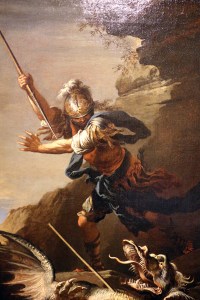
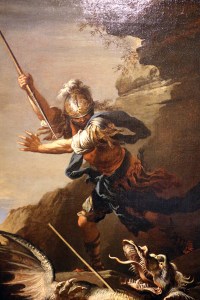
Photo courtesy: Wikipedia – “Salvator rosa, san giorgio e il drago” by Salvator Rosa (1615 –1673)
Should I with tongues of men and angles speak,
And with my arms and hands uphold the weak;
And though a prophet I should walk in fame,
And garner all men’s praises to my name,
But have not love -
What am I?

Should all my faith abound to shift a hill
Into the sea, and make its splash be still;
Or should I throw my body to the flames
And care not that my face should suffer shames,
Yet give no love—
What am I?

And should my understanding shake the proud,
And all my goods be sold to feed a crowd;
Or should my gifts of pen and talent reach
Beyond the stars, my daily efforts teach
The young—
But without love,
What am I?

Love suffers—and it suffers long;
It is not bitter when it endures wrong,
And though it knows its talents rare may be
Love finds no joy though all the world should see.
It sees a need—and then it serves;
It does not force the love that it deserves,
And even when its patience is provoked
Will not behave on feelings ill-evoked.

It’s mind is clear—rejecting lies;
No matter every failure, still love tries
To live in hope, and bear its burden still
Though hell should tempt each angle of its will.
Love’s back is strong; its hands are rough
From doing more for needs than is enough
Because it knows the seeds it sows through God
Will reap a harvest in the path it trod.

Perfection love will not demand;
It only asks for care behind the hand
That gives, and heart behind the words that spill
A stream of life, and stems the words that kill.
But love like this—where shall we ever find?
For we behind this darkened glass are blind
And see not as the Perfect One sees us,
Perhaps it is His love that we must trust…

To be the Hands, the Voice we cannot be
In our own strength of “man’s own good” in me
That rivals best in God, until it sees its need
And casts itself beneath the Hands that bleed.
O Love, upon that jagged cross of wood!
That spoke “It’s done!” though it was me who stood
Beneath its shadow, in my crippled state
Resigned to perish in a devil’s fate!

How shall my mouth and hands accept such good
As flows in torrents off that cross of wood,
And strikes the lintel of my poor, weak heart
And all the love of God to me imparts?
“Please help me, Lord, believe and bear in love;
Accept in meekness Your life from above,
And let my flesh with Christ be crucified
And every motive in You sanctified.”

Thus let me walk in quiet unity
Along life’s path, forsaking vanity
As fixing eyes upon the Saviour’s face
My helplessness bespeaks His work of grace,
And “self” becomes a theme of nothingness
That blends into His flawless plan of bliss
While every action speaks of virtues three—
Sweet faith, fair hope,
And ageless charity.
CITATIONS & SUGGESTED READING:
1 CORINTHIANS 13
1 JOHN 4:7-21
HEBREWS 2:10; 7:11, 19; 13:20-21
GALATIANS 5:22-26; 6:9, 14-15
EPHESPIANS 2:7-16; 4:13-16, 29-32
PSALMS 138:8
My Utmost for His Highest: “December 9th: The Offence of the Natural” by Oswald Chambers
Dedicated to the memory of WWII Veterans Mr. Roy Wingfield and Mr. Alex Grotkowski;
And to the known and unknown soldiers of today who lay down their lives in loyalty to truth, justice, and freedom.

The wind is cold and bitter is the blast
That bows across these desolate plains,
Where the Grim Reaper in gloom o’er passed
The bodies which fell on the Battle’s domain.
But the weary wind through the pine boughs blowing
Is weeping with tears neither hollow nor dearth,
It glides as a phantom and speaks to the earth,
Saying, “This is the place where their blood was flowing.

“Fearest thou death? O stranger come hither,
And behold with thine eye – tremble not!
Canst thou not hear through the echoing years
The combats loud din, see the dreadful feud fought?
Hark ye the cry of the stout, bold, and brave,
Canada’s troops who stepped forward to save,
‘For country, for sovereignty - cut through the fray!
For pride of dominion – though death be our pay!’

Charged they fearless to the battlefield,
Forward! Forward! They gallantly strode!
Though a bloody fight for them was sealed,
Though for some certain death was the ill forebode...
Now they lay silent, poppies shelter their grave,
These warriors fought for us – stout, bold and brave!
They suffered, they died, in the tumult of war,
The friend and the foe sided by side in the gore.”

Tarnish not worth as time duly passes
O’er their bodies and memories,
For still the wind blows through these fading grasses
Asking us now to reverence their stories...
“They died in their glory, for honour and fame,
Their brave-hearted work let us ever proclaim;
Forget not their blood, the crimson turf staining,
And remember their lives... in silence remaining.”
Originally published November 2012 by WISDOM Family Magazine








 At the Brook's Bend